
- What Are Spring Weeds in Lawns?
-
Most Common Spring Weeds to Identify in Your Lawn
- Dandelion (Taraxacum officinale)
- Henbit (Lamium amplexicaule)
- Purple Deadnettle (Lamium purpureum)
- Common Chickweed (Stellaria media)
- Annual Bluegrass (Poa annua)
- Creeping Charlie (Glechoma hederaceae)
- Crabgrass (Digitaria spp.)
- Wild Garlic (Allium vineale)
- Broadleaf Plantain (Plantago major)
- Spotted Spurge (Euphorbia maculata)
- Yellow Nutsedge (Cyperus esculentus)
- How to Prevent Spring Weeds in Your Lawn
- How to Eliminate Established Spring Weeds
- Similar posts:
What Are Spring Weeds in Lawns?
Spring brings seasonal weeds to your turfgrass. These unwanted plants fight your lawn for nutrients, water, and sunlight, making everything look less appealing. We classify them by their physical traits – their leaves, flowers, and how they reproduce. Knowing the exact genus and species of each weed helps you pick the right herbicides and control methods.
Winter annuals are one type of spring weed. They sprout in fall and early winter, usually dying off when warmer weather hits in spring or summer. But in cooler areas, they can stick around until early summer.
What is the Difference Between Broadleaf, Grassy, and Sedge Weeds?
Weeds fall into three main groups: broadleaf, grassy, and sedge weeds. Broadleaf weeds are dicots. They have wide leaves with net-like veins, varied stem shapes, and often showy flowers.
Grassy weeds, as monocots, look like turfgrass. Their leaves are simple, veins run parallel, and stems are solid.
Sedges resemble grass but grow solid, triangular stems with leaves in three ranks.
These differences matter when choosing herbicides. For instance, post-emergent sprays work on broadleaf weeds, but pre-emergent products hit grassy weeds.
How Do Spring Weeds Affect Your Lawn?
Spring weeds hurt your lawn. They fight turfgrass for food, water, and sunlight. This struggle makes your grass weak and thin. Things like henbit grow fast, creating thick mats that kill off the grass. Dandelions make thousands of seeds, so they spread quickly. Most people confuse annual bluegrass for real grass – but it grows in clumps and is hard to get rid of. Too much water helps weeds like chickweed and annual bluegrass take over. In the end, weeds make your lawn look bad and become unhealthy.
Most Common Spring Weeds to Identify in Your Lawn
When spring arrives, many common weeds pop up in lawns. Each kind needs proper identification so you can control it effectively. Some are grassy weeds, like Crabgrass or Dallisgrass. Others are broadleaf types, such as Henbit, Chickweed, and Prostrate Spurge.
You might also spot Slender aster, Annual bluegrass, Smutgrass, Purple nutsedge, Yellow nutsedge, and Green Kyllinga. Beyond these, look for Wild parsnip, Queen Anne’s Lace, wild buckwheat, waterhemp, Palmer amaranth, musk thistle, and horseweed. Knowing exactly what you are dealing with is the first step toward managing weeds well.
Dandelion (Taraxacum officinale)

Dandelions (Taraxacum officinale) are broadleaf perennial weeds, seen everywhere. Their bright yellow flowers soon turn into fluffy seed heads, holding thousands of seeds. The wind carries these seeds far and wide.
Dandelions have deep taproots, which makes them hard to get rid of completely. Pulling them by hand works if you dig out the whole taproot before the plant goes to seed. To stop new dandelions, spray a pre-emergent herbicide early in spring. For large outbreaks, a broadleaf post-emergent herbicide can help.
Henbit (Lamium amplexicaule)

Henbit – Lamium amplexicaule – is an annual weed with broad leaves that show up early in spring. It has square stems and purple, tubular flowers. This plant quickly spreads in thin or bare lawn areas, making thick patches. People often mistake it for purple deadnettle. But henbit’s top leaves attach right to the stem, unlike purple deadnettle, which has leaf stalks. Its early arrival means you need to get on top of weed control fast.
Purple Deadnettle (Lamium purpureum)

Purple deadnettle (Lamium purpureum) is a common annual weed with broad leaves. It sports square stems and fuzzy, triangular leaves; these leaves often turn purple as they age. This plant grows best in cool, damp soil. It spreads fast.
Common Chickweed (Stellaria media)

Common chickweed – Stellaria media – is a low, aggressive broadleaf weed. It has light green leaves and tiny white flowers. This weed loves moist, shady spots, often creating thick mats that suffocate grass. Too much water in your lawn practically invites it.
Seeing a few chickweed plants? Hand-pull them. Their roots are shallow, making this an easy task. To stop new chickweed from growing, apply a pre-emergent herbicide in early spring. If the chickweed is already established, a post-emergent herbicide will help. Proper watering and good lawn drainage cut down on chickweed problems.
Annual Bluegrass (Poa annua)

Annual bluegrass (Poa annua) is a grassy weed often mistaken for desirable turfgrass. It grows in clumps, displaying a pale green color, and produces small seed heads. This annual weed germinates in spring. Unlike other weeds, annual bluegrass prefers well-manicured lawns. Overwatering creates ideal conditions for its growth. To prevent germination, apply pre-emergent herbicide in late summer or early fall.
Creeping Charlie (Glechoma hederaceae)

Creeping Charlie, also known as ground ivy, is a perennial broadleaf weed belonging to the mint family. It is distinguished by its kidney-shaped leaves with scalloped edges, which encircle the stem, and purple flowers that bloom in spring. When crushed, the plant emits a strong mint-like scent. This weed spreads aggressively along the ground, often forming low, creeping growth, and thrives in moist, shady areas, although it can tolerate sun.
Crabgrass (Digitaria spp.)

Crabgrass (Digitaria spp.) is an annual grassy weed. Its leaves and stems are thick, spreading out like crab legs. In the fall, crabgrass makes thousands of seeds. These seeds sprout in early spring when the soil hits 55°F.
You can stop seeds from germinating with a pre-emergent herbicide. For crabgrass that’s already grown, use a post-emergent grassy weed control. Mowing grass higher also helps – it shades the soil, keeping new seeds from growing. Frost in the fall kills the full-grown weed, but it always comes back because of all those seeds dropped earlier.
Wild Garlic (Allium vineale)

Wild Garlic (Allium vineale) is a common spring weed found in lawns. This plant is a bulbous perennial, making it difficult to control due to its underground bulbs. Effective management requires targeted strategies, including cultural practices and herbicides.
Broadleaf Plantain (Plantago major)

Broadleaf plantain (Plantago major) pops up everywhere. Its wide, oval leaves grow in a flat rosette, right against the ground. This weed can handle compacted soil and lots of foot traffic. It’s tough, so it often becomes a real problem in lawns. To get rid of it, you need to improve the soil and use broadleaf herbicides.
Spotted Spurge (Euphorbia maculata)

Spotted spurge (Euphorbia maculata) is an annual broadleaf weed. It grows in a low, mat-forming pattern. Look for a reddish-purple spot in the center of its leaves. Breaking the plant releases a milky sap. This weed loves hot, dry conditions. It quickly takes over bare or thin spots in a lawn.
Pulling young spotted spurge by hand in spring works well. But its seeds are tough. They resist removal, so you need to keep pulling them to stop the weed from coming back.
Yellow Nutsedge (Cyperus esculentus)
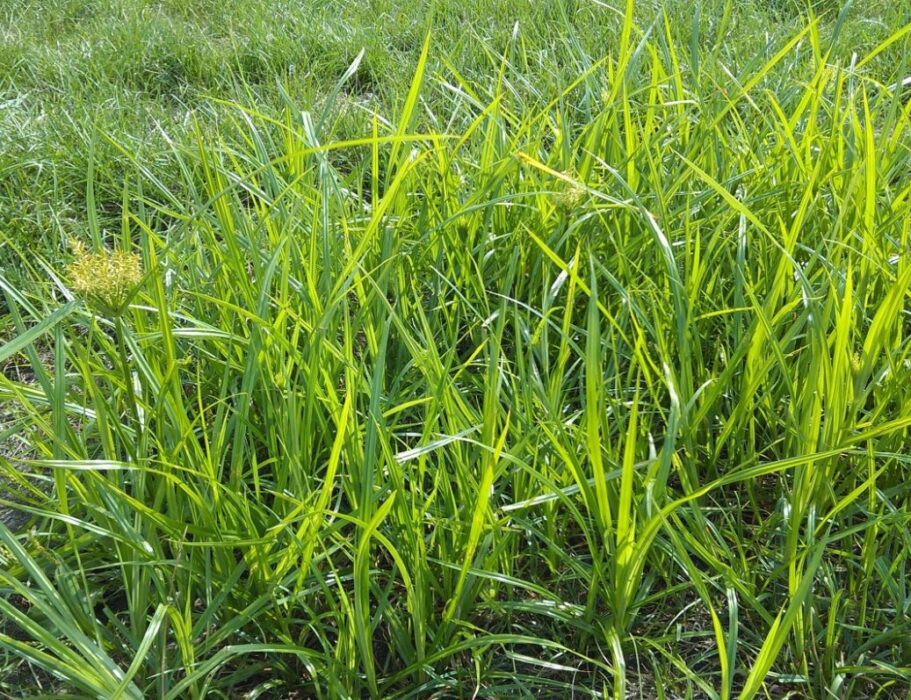
Yellow nutsedge (Cyperus esculentus) is a tough perennial, often mistaken for common grass. You can spot it by its triangular stems and bright, yellowish-green leaves. These leaves shoot up much faster and taller than regular turfgrass. This weed tends to live in wet, muddy soils.
You can fight it several ways. Fix your drainage system first. For small patches, just pull them out by hand. Otherwise, you’ll need special herbicides meant for sedges. The plant itself spreads fast – sending out rhizomes, seeds, and underground nutlets.
How to Prevent Spring Weeds in Your Lawn
Weeds fight turfgrass for nutrients, water, and sunlight, so stopping them in spring keeps your lawn healthy. Proactive prevention offers the best way to handle recurring weed problems. Put down a pre-emergent herbicide in early spring; this controls grassy weeds before they sprout. Raise your mower to 3 to 4 inches – taller grass shades the soil and crowds out weed seedlings.
Keep your soil pH balanced, between 6.2 and 7.0. A good pH helps grass get its nutrients and keeps weeds away. Water your lawn deeply, but not too often. This builds a deep root system (better for fighting weeds). Overseeding and aeration also help make your lawn thick and healthy, which naturally chokes out weeds. You can also mulch garden beds to stop weeds there.
How to Eliminate Established Spring Weeds
Once spring weeds are set, remove them by hand or with post-emergent herbicides. Pulling works for small patches, especially for shallow-rooted types like chickweed. Dandelions, though, need their whole taproot out, or they just grow back.
For larger weed problems, spray post-emergent herbicides right on the plants. You can hit existing crabgrass this way. And a pre-emergent can stop new growth. Canada thistle needs mowing or pulling before it flowers; often, you’ll need both pre- and post-emergent sprays to control it. Common lamb’s-quarters are easiest to hand-pull when they’re young. Pre-emergent herbicides will keep them from sprouting at all. Controlling weeds well takes both knowing what to do and having patience.